AxisFit
3D-driven functional-training app - web + mobile share one bone-rig engine that animates every exercise.
AxisFit is a fitness app where every exercise plays as a 3D-rigged figure you can rotate. The same animation engine drives the Next.js web app and the Expo native app, so a new exercise is one set of keyframes for both surfaces. Workout plans, the exercise library, and a progress dashboard ship on day one.
ListenVideo demos break on the train, and a single camera angle never tells you what your hip should do. Built a 3D-rig engine where every exercise rotates with you - and the same engine runs on web and native.
AxisFit ships as a Next.js web app and an Expo native app off a single TypeScript engine that animates a bone-rig per keyframe set. Every exercise - squat, deadlift, push-up, pull-up, plank, lunge - is one set of keyframes, and the engine handles the grip, the ground alignment, and the hang. Adding a new exercise touches one file and goes live on web, iOS and Android together.

Every fitness app we'd seen was either flat illustrations or a single-camera video that breaks on the train. The team built one where the body is a 3D model you can rotate on the screen, and the same animation plays on the website and the phone app - both shipped at once. Adding a new exercise takes minutes, not a separate video shoot.
What's on screen
Frame breakdown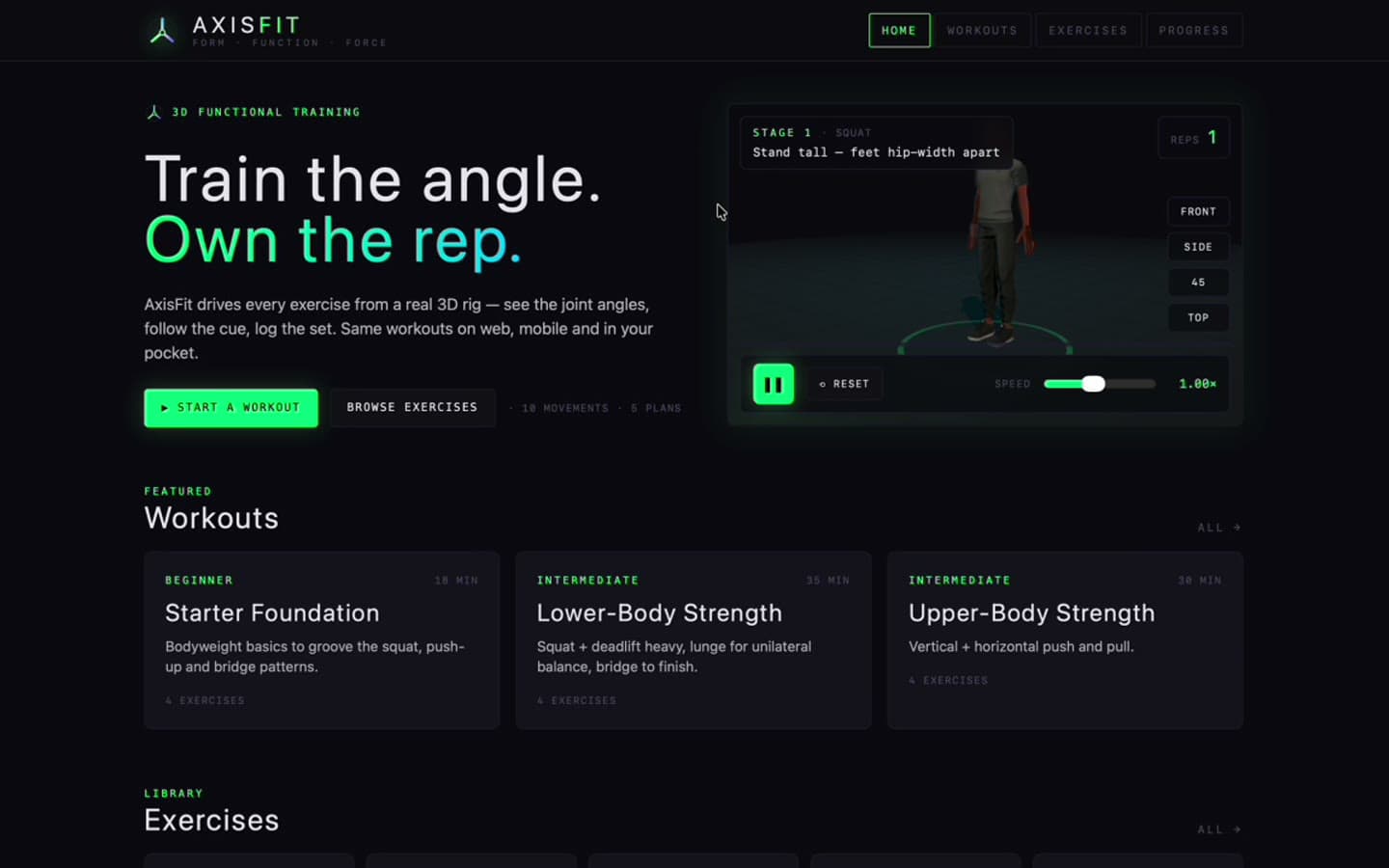
- 01User surface
The whole experience the user sees
This frame shows the live product: 3d-driven functional-training app - web + mobile share one bone-rig engine that animates every exercise. Every component is ours · scope, design, code, deploy.
- 02Stack behind the screen
What's powering it: Next.js, React Three Fiber, Expo
5 stack components run behind this frame · Next.js, React Three Fiber, Expo drive the visible UI; the rest sit in the data layer. All studio-owned.
- 03What we shipped
3D-rig exercise animations · web + native, one engine
Every exercise is rotatable and offline-ready
- 04Status
Private deploy · under NDA.
Per the client's request the URL stays private · the build, architecture, and lessons can be shared in a scoping call.
How it shipped
Timeline- 01 · BRIEF
Pin 'every exercise is 3D, no video' - and one engine for both surfaces.
Decision the project rested on: same engine on the web and on the phone, so a new exercise is one keyframe set instead of two parallel implementations.
- 02 · ARCHITECTURE
Stack decisions before any code.
Decision doc captured the data flow, Next.js, React Three Fiber, Expo, TypeScript role split, and the failure modes we'd handle in v1 vs defer. Cross-service boundaries (where AI ends and the web app begins) were drawn here so neither side leaked into the other later.
- 02 · BUILD
Extract the rig engine into a shared package, drive both surfaces from it.
@axisfit/shared holds the engine, exercise metadata, sample plans, the progress contract. Native renders through expo-gl + expo-three; web renders through react-three-fiber. Both surfaces hand a rig + scene to the same ExerciseRunner, which lerps keyframes, ground-/hang-aligns the body and applies grip orientation.
- 04 · POLISH
Performance, accessibility, and observability.
PSI / a11y / coverage budgets enforced as launch gates. Logging + metrics wired before cut-over · the team can answer 'is it working?' from a dashboard, not a Slack thread. Threat-model checklist signed off before traffic hits the box.
- 03 · SHIP
Library, player, dashboard - live on web, iOS and Android.
Three surfaces went out the door at the same time on the same engine. Adding a new exercise - keyframes only - deploys to all three.
What shipped
04- 01Engine
Keyframe-driven bone-rig
mapBones · applyPoseFrame · doGroundAlign · ExerciseRunner - the engine is shared TypeScript, no duplication between web and native.
- 02Library
10+ exercises on day one
Squat, deadlift, push-up, pull-up, plank, lunge - and the equipment around them, built locally per surface so the engine stays equipment-agnostic.
- 03Player
Workout flow with progress
Plan → set → rep with a per-frame ticking rig; native uses a PanResponder orbit camera so the athlete picks the angle that helps.
- 04Dashboard
Session log + summary
SessionEntry + summarize() with a pluggable Storage interface - localStorage on web, AsyncStorage on native, the same contract.
From the video
Frame by frame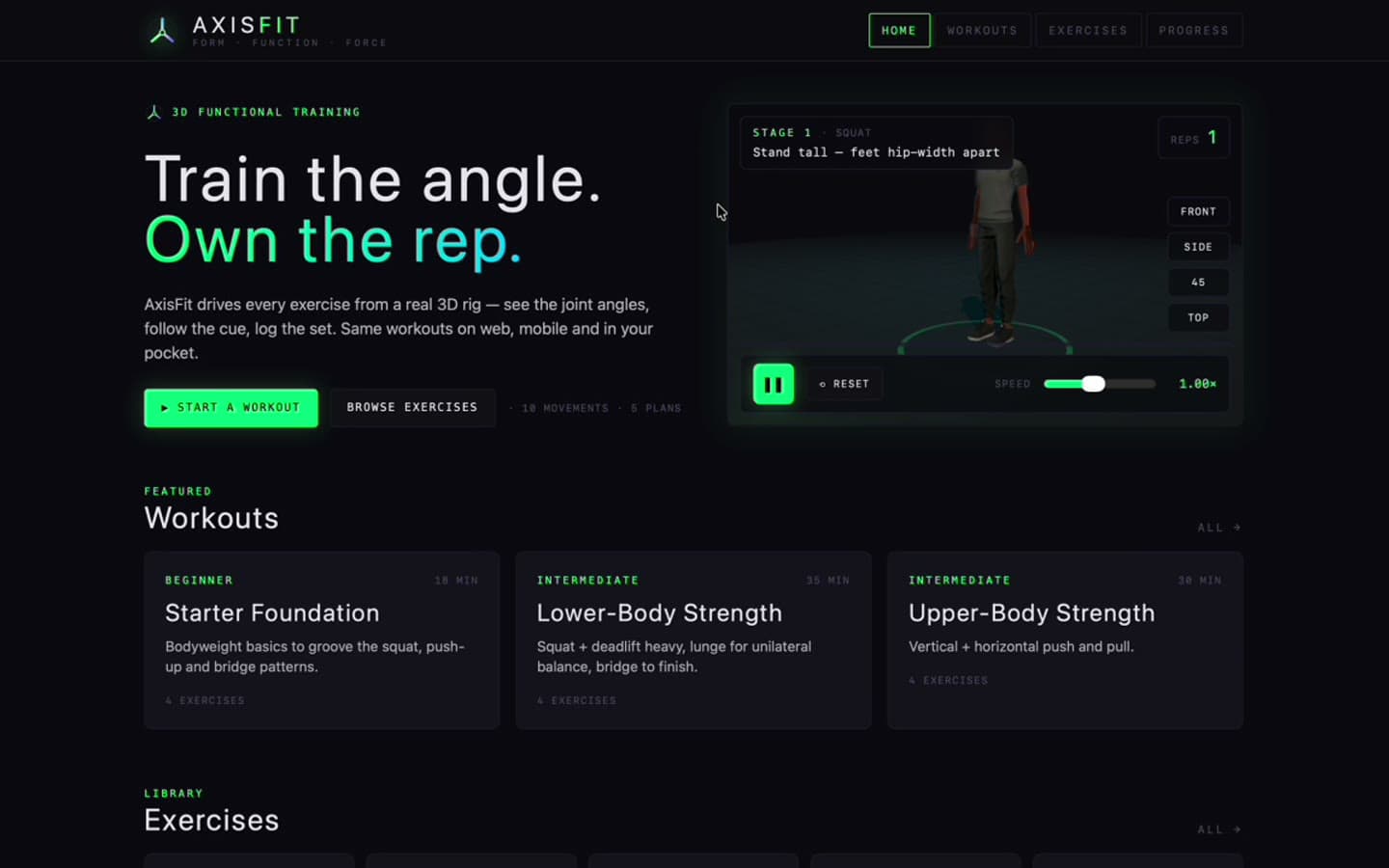 01Frame
Landing · Train the angle. Own the rep.
Three-axis isometric glyph (X/Y/Z = the joint axes the engine rotates around) with the tagline Form · Function · Force. The 3D rig stands on the page from the first second.
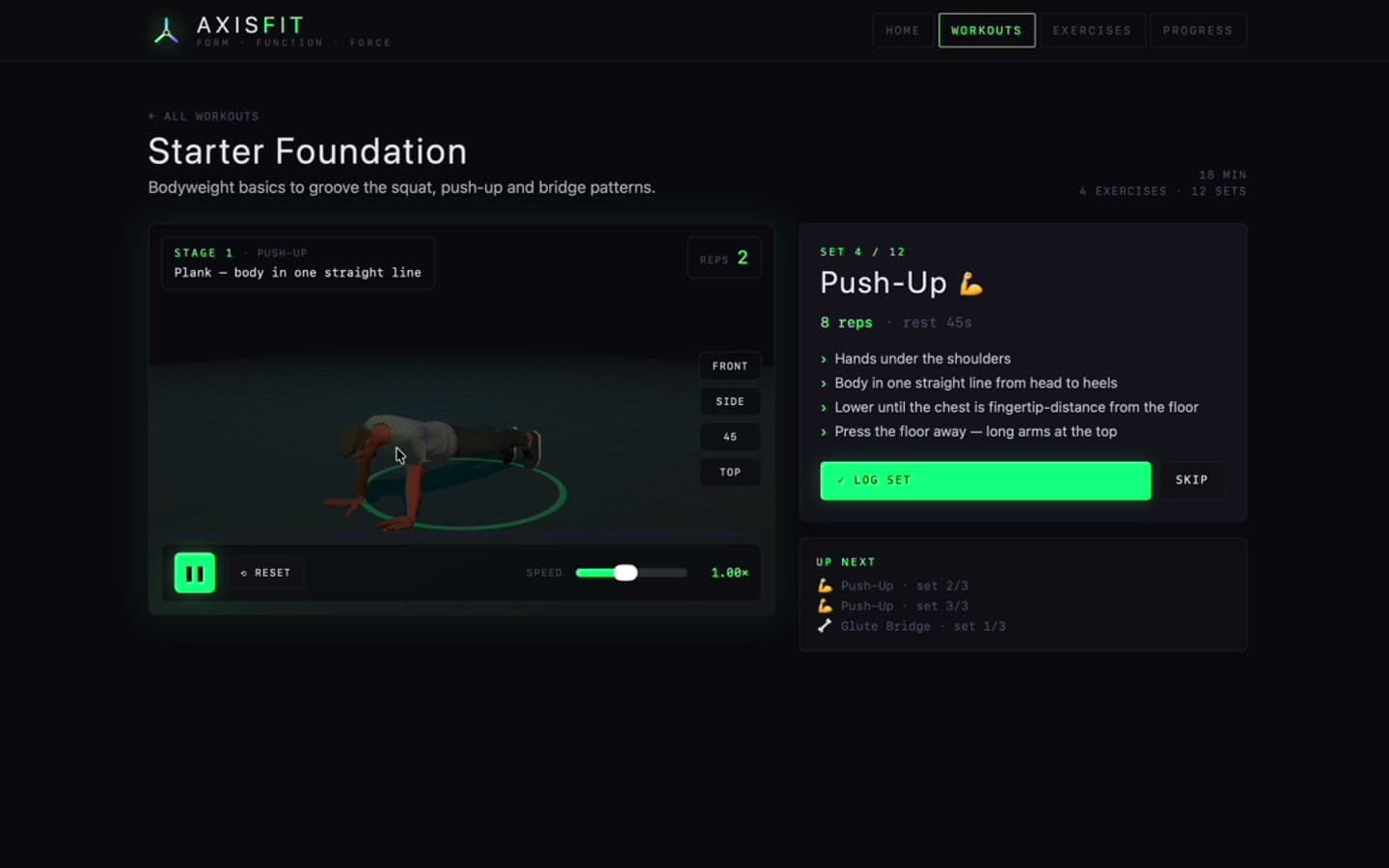 02Frame
Workout player · Squat with grip and ground align
Per-frame ticking lerps the keyframes; the engine grounds the feet and orients the grip - same code path on web and native.
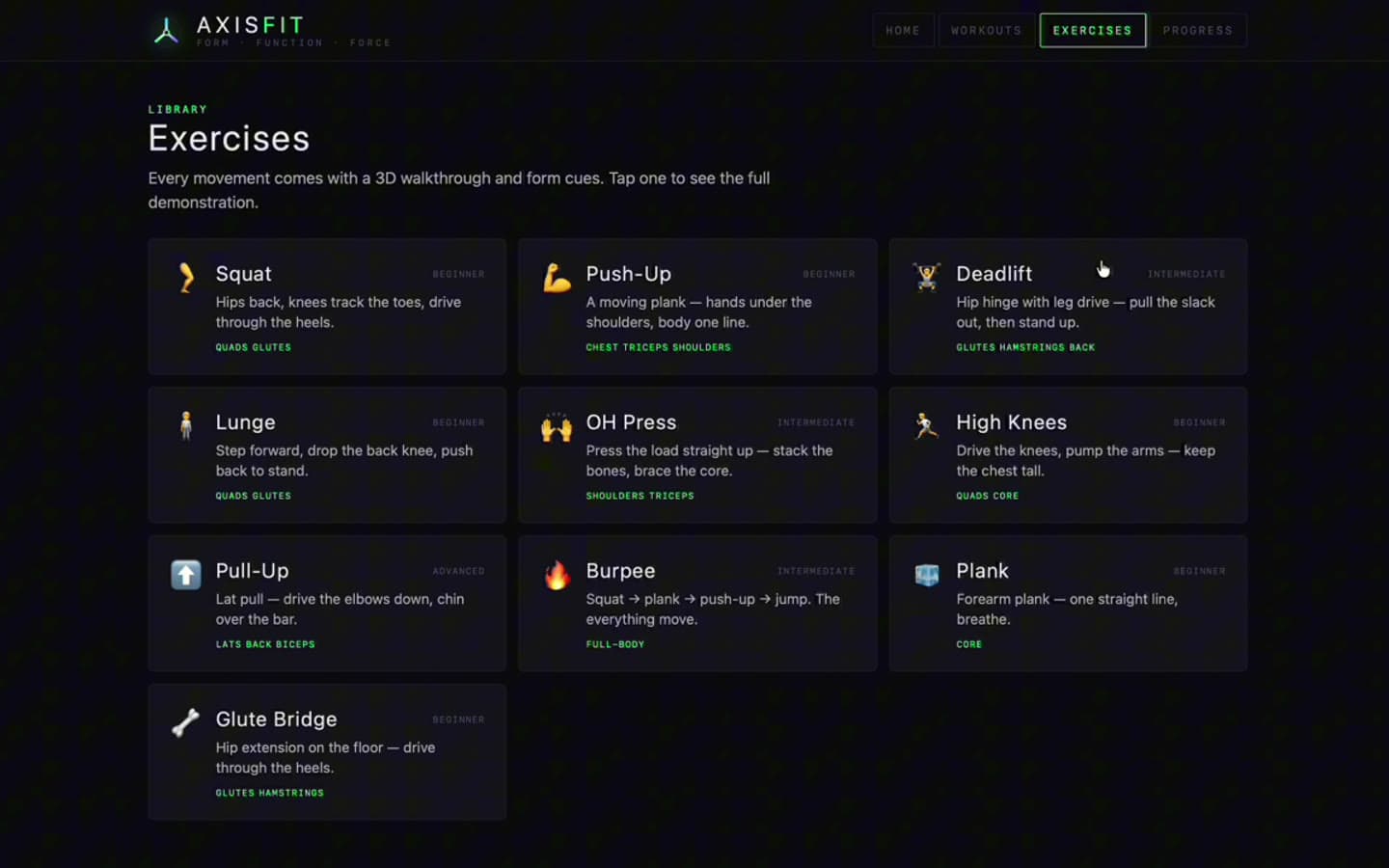 03Frame
Exercise library · 10+ cards, one engine
Every card uses the same engine - open one, the rig is interactive on the spot, not a video frozen at a pose.
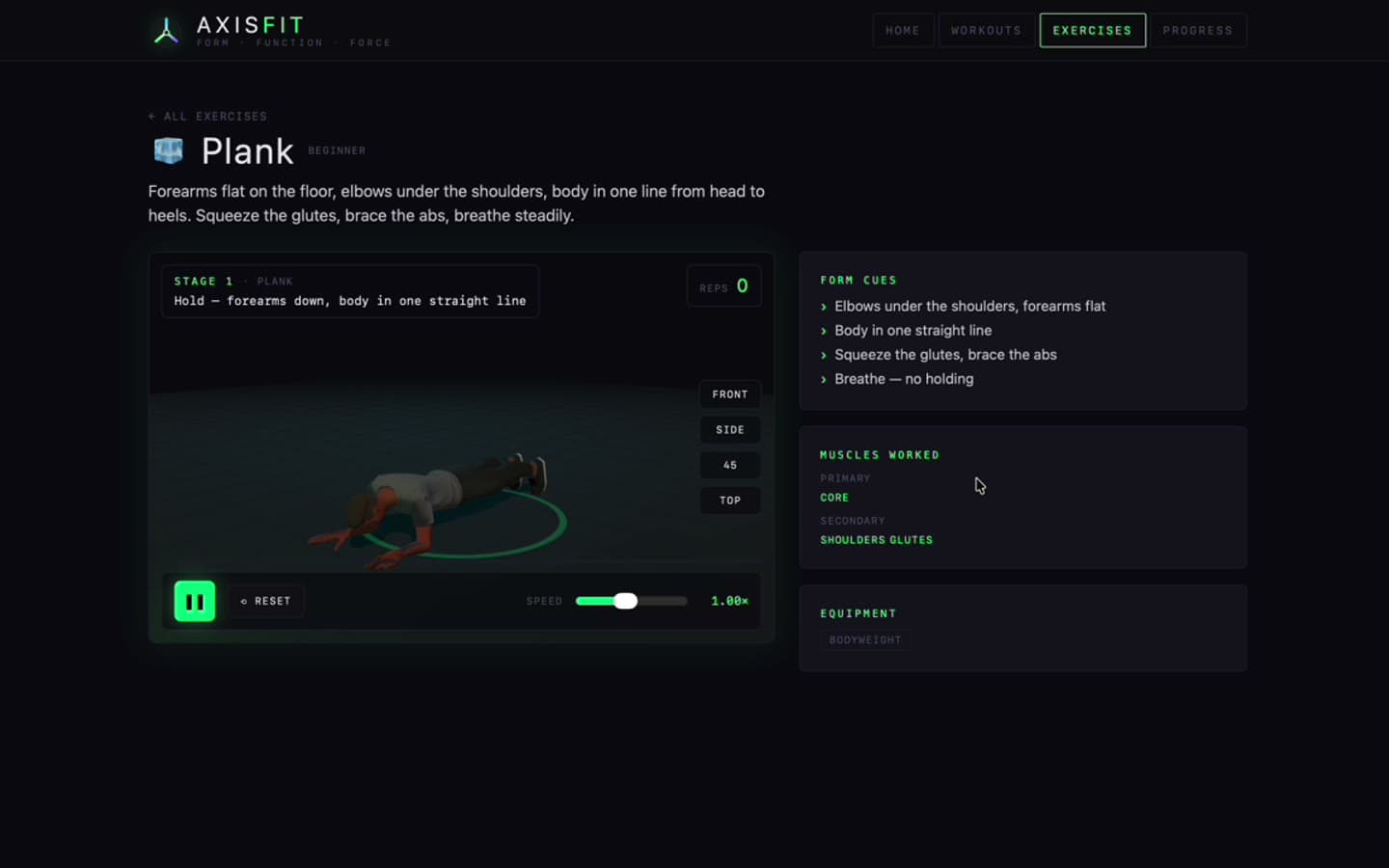 04Frame
Plank · ground-aligned, side-camera
Ground alignment makes static holds readable from any angle · the athlete can pick the side-camera that actually checks the hip line.
THE PROBLEM
- −Video demos break on phones with poor reception
- −Form cues are hard to read from a single camera angle
- −Two parallel codebases for web + native doubles every change
WHAT THE CLIENT GOT
- Every exercise is rotatable and offline-ready
- Form reads from any angle the athlete picks
- One engine, one content set · ship features in one place
WHAT WE DELIVERED
- +3D-rig exercise animations · web + native, one engine
- +Workout library + workout player + progress dashboard
- +A single content set drives both surfaces
- +Bone-aware grip + ground/hang alignment per rep
STACK
- Next.js
- React Three Fiber
- Expo
- TypeScript
- Three.js
RELATED READING
- AI solutions · Websites, web apps & online shops · Cybersecurity · Custom software · everything elseQ3 2026 roundup: what shifted, what we shipped, what brokeThree months in. SZEP 2.0 live, NAV v3 cutover, AI Act enforcement, OWASP LLM Top 10 v2. Hard numbers, one strong opinion on the consulting tier.
- AI solutions · Custom software · everything elseDoes your AI phone assistant have to tell callers it's AI? (EU, 2026)Short answer: yes, and it's simpler than most people fear. One natural sentence at the start of the call does it — here's the rule, the timing, and how we build it.
- AI solutions · Custom software · everything elseAI Receptionist for Auto Shops: Never Miss a Booking Call (2026)Garages lose jobs to unanswered calls, especially at tyre-change and MOT peaks. How an AI receptionist books every slot 24/7.
- AI solutions · Custom software · everything elseAI Receptionist for Clinics: End Missed Calls and No-Shows (2026)Every missed call is a lost patient. How an AI receptionist answers 24/7, books, and cuts no-shows, plus the honest ROI and cost.